Ozone Odour Control for Pet Food Factories | Complete Guide
Pet food manufacturing plants often struggle with persistent odours caused by proteins, fats, and organic residues. These smells can impact employee comfort, nearby communities, and regulatory compliance.
One of the most effective and increasingly popular solutions is ozone (O₃) odour treatment.
What Causes Odours in Pet Food Factories?
Pet food odours come from several sources:
- Protein breakdown (ammonia, sulphur compounds)
- Cooking and extrusion processes
- Waste handling and storage
- Wet processing areas and drains
These compounds are often:
- Airborne
- Sticky (adhere to surfaces)
- Difficult to eliminate with standard ventilation
That’s why traditional air filtration alone often fails.
What Is Ozone and How Does It Work?
Ozone (O₃) is a highly reactive gas made of three oxygen atoms. It works by oxidising odour-causing molecules.
The science (simplified):
- Ozone reacts with volatile organic compounds (VOCs)
- It breaks down odour molecules at a chemical level
- It converts them into:
- Oxygen (O₂)
- Carbon dioxide (CO₂)
- Water (H₂O)
Result: Odours are destroyed, not just masked.
Why Ozone Is Ideal for Pet Food Odour Control
1. Eliminates Odours at the Source
Unlike air fresheners or masking agents, ozone:
- Targets the actual chemical compounds
- Removes odours permanently
2. Reaches Hard-to-Treat Areas
Ozone is a gas, so it can penetrate:
- Ductwork
- Production machinery
- Storage areas
- Drainage systems
This is critical in complex factory environments.
3. Reduces Bacteria and Biofilms
Ozone is also a powerful antimicrobial agent:
- Kills odour-causing bacteria
- Helps prevent biofilm build-up
- Improves hygiene standards
4. Chemical-Free Odour Treatment
Ozone is generated in-situ on-site using oxygen and electricity:
- No need for transported chemicals
- Leaves no residue
- Environmentally friendly when properly managed
5. Supports Regulatory Compliance
Many facilities face:
- Local odour complaints
- Environmental regulations.
Odour control in pet food manufacturing is a legal requirement in the UK and across Europe, not just a best practice. Under the Environmental Protection Act 1990, strong smells from industrial sites can be classified as a statutory nuisance if they harm health or interfere with people’s quality of life, meaning local authorities are required to investigate and take action. Many facilities also operate under environmental permits, where odour is treated as a form of pollution alongside emissions to air or water, requiring monitoring, reporting, and the use of appropriate control measures. At a European level, the Industrial Emissions Directive reinforces this by requiring companies to adopt Best Available Techniques (BAT) to minimise environmental impact, including odours.
Failing to control odours carries significant risks. Businesses can face abatement notices, fines, or legal action, and in serious cases may be forced to reduce or stop operations altogether. Beyond legal consequences, unmanaged odours can lead to community complaints, reputational damage, and restrictions on site expansion or permitting. They can also disrupt operations and create poor working environments. Ultimately, effective odour control is essential not only for compliance, but for protecting a company’s long-term reputation, operational stability, and ability to grow.
Best Practices for Implementing Ozone Systems
To get the best results:
1. Conduct an Odour Assessment
- Identify key odour sources using olfactory or GC-MS testing to ensure all odour compounds can be oxidised using ozone.
- Measure intensity and airflow
2. Choose the Right System
- Ensure the ozone generator is the correct size; consider the odour compounds present, the volume of air/ flow m3/h and contact time
3. Integrate with Existing Systems
- Typically linked to clients existing extraction fans
4. Monitor and Optimise
- Complete odour analysis to ensure treatment is effective
- Install ozone sensors to monitor the ozone
Key Benefits Summary
- Eliminates odours at molecular level
- Improves hygiene and air quality
- Reduces complaints and compliance risk
- No ongoing chemical costs
- Versatile across factory zones
- Compact and simple Installation v’s larger odour abatement solutions
FAQs About Ozone in Pet Food Odour Control
1. Is ozone safe to use in pet food factories?
Yes, when properly controlled. Ozone systems must be designed to meet workplace exposure limits and should not expose workers to high concentrations.
2. Does ozone remove or just mask pet food odours?
Ozone removes odours completely by chemically breaking down the molecules — unlike masking agents, which only cover smells.
3. Can ozone damage equipment or materials?
At controlled levels, ozone is safe for most industrial environments. However, very high concentrations over time can degrade certain materials like rubber. Best to check the material of the ductwork to ensure longevity.
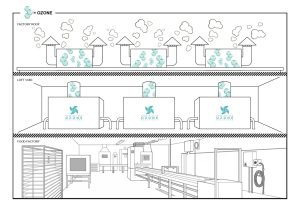
4. Where should ozone generators be installed?
Common locations include:
- Ventilation systems – extraction ducts
- Production rooms
- Waste areas
Placement depends on airflow and odour sources.
5. Is ozone better than carbon filtration?
In many cases, yes. Ozone:
- Destroys odours instead of trapping them
- Requires less ongoing maintenance
But carbon filters can still be used alongside ozone for best results. Ozone can be injected prior to carbon filters and is extremely useful at prolonging the life of the carbon filter bed, it works by removing a large % of odour compounds before they reach the carbon, thus less load on the filter bed. Ozone can also be applied post carbon filter as a polishing agent, to remove any of the residual smells.
6. Can ozone help with hygiene as well as odour?
Yes. Ozone:
- Kills bacteria – that cause odour and illness
- Reduces microbial growth
- Supports sanitation processes
7. Does ozone leave any residue?
No. Ozone naturally breaks down into oxygen, leaving no chemical residue.
8. How quickly does ozone remove odours?
Results can be noticeable within minutes to hours, depending on:
- Odour intensity
- System size
- Airflow conditions
- Contact time
9. Can ozone be used during production?
Ozone odour control is on all the time products are being produced and cooked. If the oven is on the ozone is linked to this to ensure all cooking odours are being removed whilst the oven is running.
10. Is ozone cost-effective?
Yes. While initial setup costs exist, ozone systems:
- Reduce chemical use
- Lower maintenance
- Provide long-term savings
- Compact design, no foundations or planning required
Final Thoughts
Ozone is one of the most effective and scalable solutions for managing pet food odours in industrial environments. When implemented correctly, it delivers:
- Cleaner air
- Better working conditions and happier neighbours
- Improved compliance
- Reduced operational headaches